
Dagre Layout
Previous
D3 Force-Directed Layout
Next
Dendrogram Layout
Loading...
Dagre is a hierarchical layout suitable for directed acyclic graphs (DAGs). It can automatically handle the direction and spacing between nodes and supports both horizontal and vertical layouts. See more Dagre layout examples, source code, and official documentation.

const graph = new Graph({layout: {type: 'dagre',rankdir: 'TB',align: 'UL',nodesep: 50,ranksep: 50,},});
For more options, refer to the official documentation
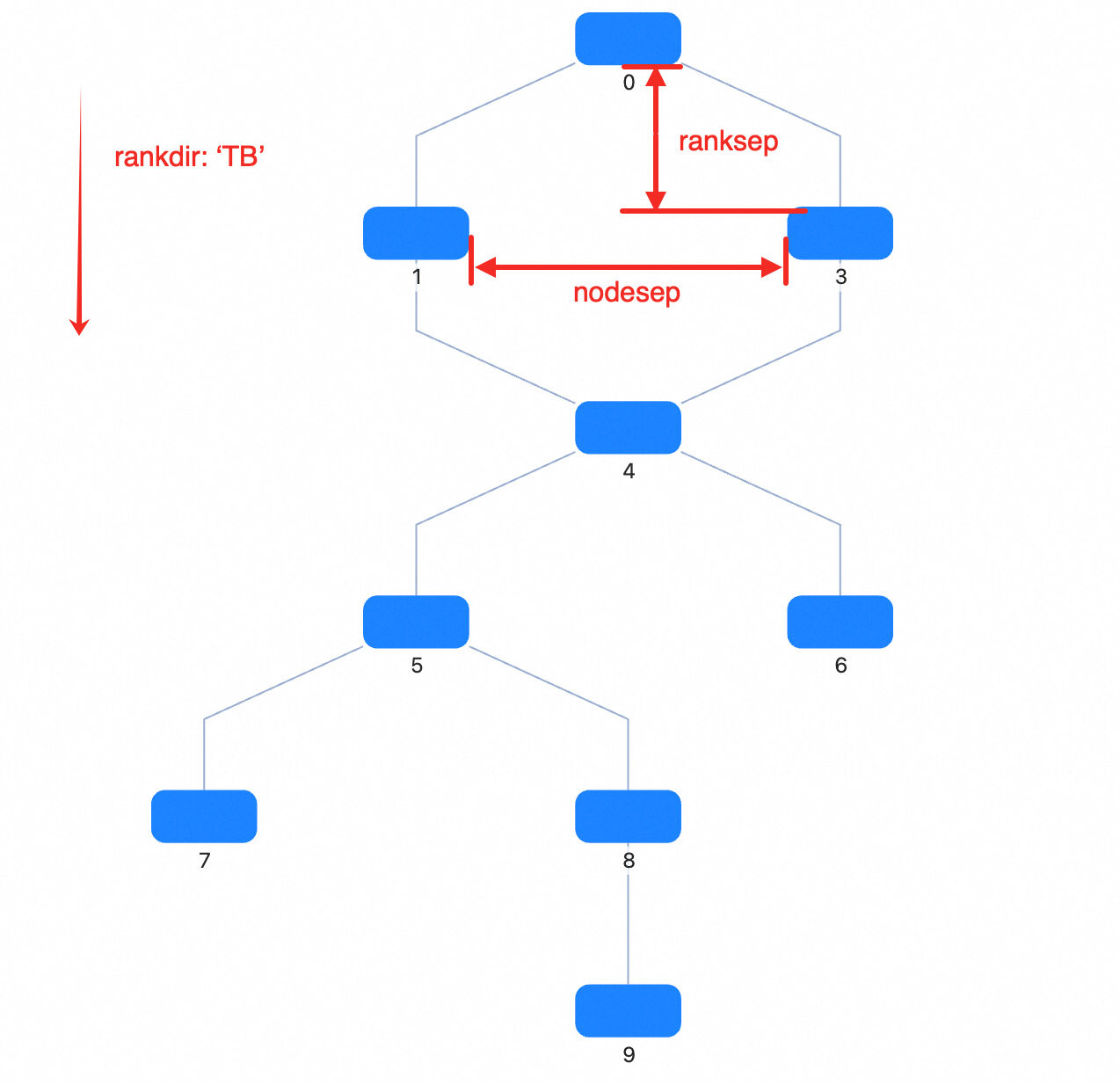
| Property | Description | Type | Default | Required |
|---|---|---|---|---|
| type | Layout type | dagre | - | ✓ |
| rankdir | Layout direction, options | TB | BT | LR | RL | TB | |
| align | Node alignment, options | UL | UR | DL | DR | UL | |
| nodesep | Node spacing (px). For TB or BT, it is the horizontal spacing; for LR or RL, it is the vertical spacing | number | 50 | |
| ranksep | Rank spacing (px). For TB or BT, it is the vertical spacing between adjacent ranks; for LR or RL, it is the horizontal spacing | number | 100 | |
| ranker | Algorithm for assigning ranks to nodes: longest-path, tight-tree, or network-simplex | network-simplex | tight-tree | longest-path | network-simplex | |
| directed | Whether to treat the graph as directed | boolean | true | |
| compound | Whether to support nested structures | boolean | true | |
| multigraph | Whether to allow multi-edges | boolean | true | |
| nodeSize | G6 custom property, specify node size for all or each node. If a single number, width and height are the same; if array: [width, height] | number | number[] | () => (number | number[]) | [0, 0] | |
| edgeMinLen | Minimum number of ranks crossed by an edge | number | (edge) => number | 1 | |
| edgeWeight | Edge weight, used to affect optimization priority | number | (edge) => number | ||
| edgeLabelSize | Edge label size, used to reserve layout space | number[] | (edge) => number[] | ||
| edgeLabelPos | Edge label position | string | (edge) => string | ||
| edgeLabelOffset | Offset between the label and the edge | number | (edge) => number |
Note:
dagredoes not require configuringcontrolPointsseparately. G6 automatically converts the polyline points returned by the layout intostyle.controlPointson the edge.
TB|BT|LR|RL, Default:TB
Layout direction
TB: Top to Bottom;
BT: Bottom to Top;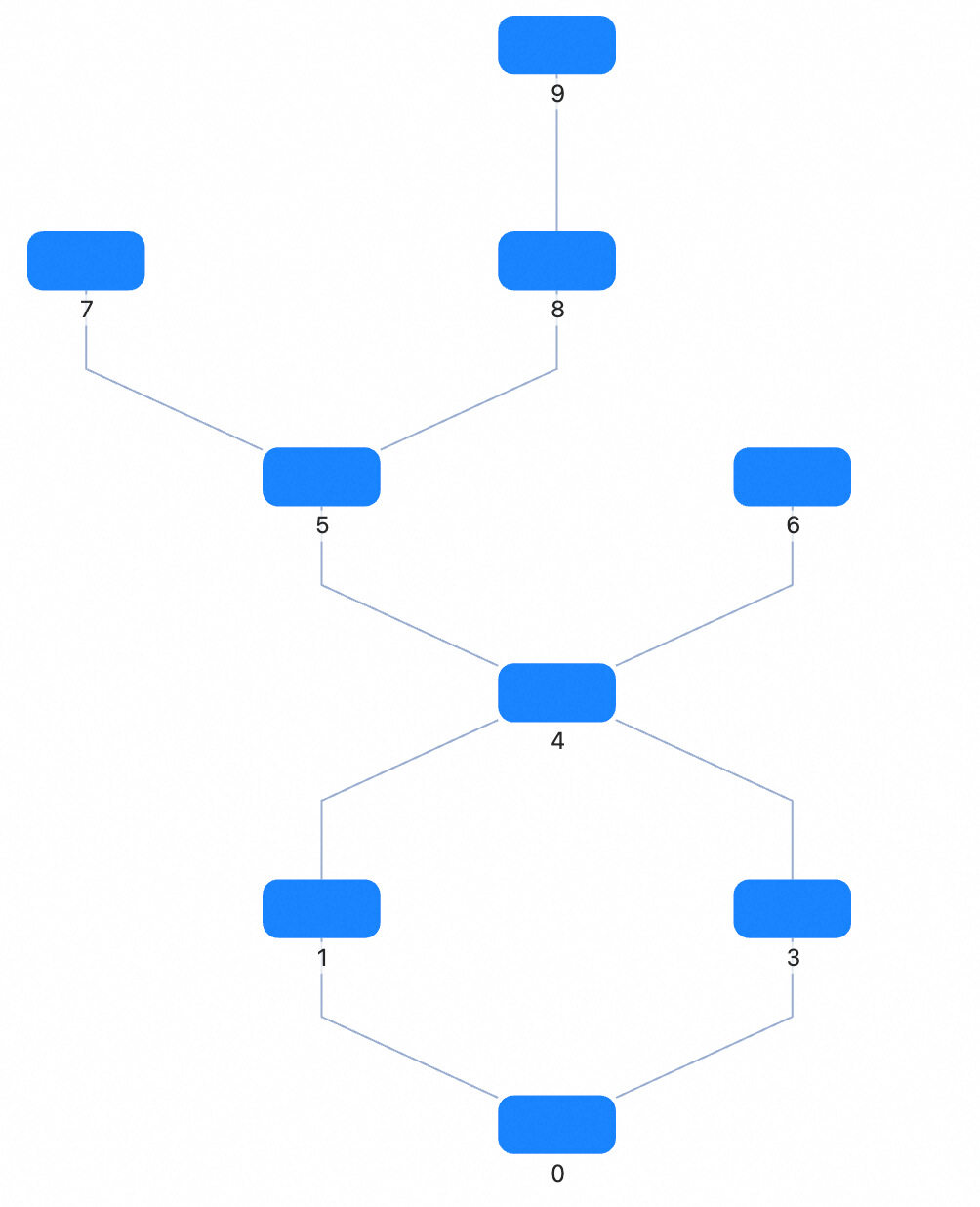
LR: Left to Right;
RL: Right to Left.
UL|UR|DL|DR, Default:UL
Node alignment
UL: Upper LeftUR: Upper RightDL: Down LeftDR: Down Rightnumber, Default: 50
Node spacing (px). For TB or BT, it's the horizontal spacing; for LR or RL, it's the vertical spacing
number, Default: 50
Rank spacing (px). For TB or BT, it's the vertical spacing between ranks; for LR or RL, it's the horizontal spacing between ranks
network-simplex|tight-tree|longest-path, Default:network-simplex
Algorithm for assigning ranks to nodes, supports three algorithms:
longest-path: Uses DFS to recursively find the longest path for each node. Simple and fast, but may result in many long edges.tight-tree: An optimization algorithm to reduce the number of long edges. It first uses longest-path to compute initial ranks, then adjusts slack edges to build a feasible tree.network-simplex: Based on A Technique for Drawing Directed Graphs, iteratively modifies node ranks to minimize slack edges.number | number[] | () => (number | number[])
G6 custom property, specify node size for all or each node. If a single number, width and height are the same; if array: [width, height]
(d) => {// d is a nodeif (d.id === 'testId') return 20;return [10, 20];};
The following documents can help you better understand Dagre layout